Autor: Claudia Samudio

  • How to Paraphrase Without Plagiarizing: Complete Guide

    Most students who plagiarize didn’t mean to. They changed a few words, moved a sentence around, and figured that was enough. It wasn’t — and their professor knew instantly. Learning how to paraphrase without plagiarizing is one of the most valuable writing skills you can develop, and this guide gives you a method that actually works.

    What Is Paraphrasing?

    Paraphrasing means restating someone else’s idea in your own words and sentence structure while keeping the original meaning intact. You still need to cite the source — paraphrasing is not a way to avoid giving credit. It’s a way to integrate someone else’s idea smoothly into your own writing.

    A good paraphrase sounds like you, not like the original author with a few words swapped out.

    The 5-Step Method for Paraphrasing Without Plagiarizing

    Step 1: Read the original until you understand it fully

    Don’t try to paraphrase while you’re reading. Read the passage once — or twice if needed — until you genuinely understand what it’s saying. If you don’t understand it, you can’t paraphrase it accurately.

    Step 2: Put the source away

    Minimize the window. Put the book face down. Don’t look at the original while you write. This is the single most effective technique for avoiding accidental plagiarism. When you can’t see the original, you can’t copy it.

    Step 3: Write the idea in your own words from memory

    Write what you remember the source saying, as if you’re explaining it to a friend. Don’t aim for the same sentence structure. Don’t try to reproduce the original’s phrasing. Just capture the idea.

    Step 4: Check your version against the original

    Now look at the original again. Compare your version. Ask: Did I capture the main idea accurately? Did I accidentally copy any phrases of three or more words? Does my version preserve the original meaning without distorting it?

    Step 5: Cite the source

    Add your in-text citation. Even a perfect paraphrase requires a citation because the idea came from someone else. In APA: (Author, Year). In MLA: (Author Page). In Chicago: use a footnote.

    Paraphrasing Examples: Before and After

    Example 1: Word substitution — still plagiarism

    Original: «Students who sleep fewer than six hours per night show significant declines in working memory and attention during academic tasks.»

    Bad paraphrase (word substitution only): Students who rest for less than six hours each night demonstrate notable decreases in working memory and focus during school assignments.

    This is still plagiarism. The sentence structure is identical; only a few words changed. Most plagiarism detectors — and most professors — will catch this.

    Example 2: True paraphrase — acceptable

    Good paraphrase: Cognitive performance in academic settings — particularly working memory and sustained attention — deteriorates measurably when students get under six hours of sleep (Smith, 2024).

    Different structure. Different word order. Same meaning. Citation included. This is what correct paraphrasing looks like.

    Example 3: Paraphrase + synthesis (the advanced version)

    Even better: Sleep deprivation harms the very cognitive skills students need most. When sleep drops below six hours, working memory and attention both decline significantly (Smith, 2024), which may help explain why all-night study sessions tend to produce worse exam outcomes rather than better ones.

    This version paraphrases the source and connects it to a broader point. That’s scholarly writing, not just source management.

    The 5 Mistakes That Get Students Caught

    • Swapping synonyms without changing structure — Plagiarism detectors and professors recognize sentence structure, not just vocabulary. If your paraphrase has the same shape as the original, it’s not a real paraphrase.
    • Paraphrasing sentence by sentence — If you take each sentence from the original and rephrase it in order, your paragraph will mirror the original’s structure and argument flow. Instead, read the whole passage, then write your own paragraph that covers the same ground.
    • Forgetting to cite a paraphrase — Many students think citations are only for direct quotes. They’re not. Every idea you take from a source — even if completely rephrased — needs a citation.
    • Paraphrasing too closely when the original is very technical — Some technical terms don’t have good synonyms. That’s fine — use the technical term. The structural paraphrase still needs to be genuinely yours.
    • Using AI paraphrasing tools carelessly — AI paraphrasers like QuillBot can produce output that reads naturally but still echoes the original structure too closely. Always check the output against the original yourself before submitting.

    When to Paraphrase vs When to Quote Directly

    Paraphrase most of the time. Use direct quotes sparingly — only when the exact wording matters. Good reasons to quote directly:

    • The original phrasing is particularly powerful or distinctive
    • You’re analyzing the language itself (literature, rhetoric, law)
    • The source is a primary document where exact wording is evidence (historical document, legal text, interview)
    • Paraphrasing would lose critical nuance or precision

    In most academic writing, the ratio should be roughly 80–90% paraphrase, 10–20% direct quote. Papers that are mostly quotes signal that the writer isn’t engaging analytically with the material.

    Paraphrasing vs Summarizing: What’s the Difference?

    Paraphrasing restates a specific passage in roughly the same level of detail. Summarizing condenses a larger section — or an entire source — into a shorter version. Both require a citation. Both require genuinely different wording from the original.

    Use paraphrasing when you need the full detail of a specific finding or argument. Use summarizing when you need to cover a broader argument or background context efficiently.

    APA Paraphrasing Citation Format

    In APA 7th edition, in-text citations for paraphrases include the author’s last name and year. Page numbers are encouraged but not required for paraphrases (they’re required for direct quotes).

    Paraphrase: (Smith, 2024)
    Paraphrase with page: (Smith, 2024, p. 47)
    Author in sentence: Smith (2024) found that…

    Frequently Asked Questions

    Can paraphrasing still be plagiarism?

    Yes. If your paraphrase is too close to the original in structure or wording, it’s plagiarism regardless of your intent. And if you paraphrase correctly but forget to cite the source, that’s also plagiarism — you’re presenting someone else’s idea as your own original thought.

    Does paraphrasing require a page number in APA?

    Page numbers are recommended but not required for paraphrases in APA 7th edition. They’re always required for direct quotations. Including page numbers for paraphrases is good practice, especially in academic papers, because it helps readers find the original passage.

    Is it okay to use a paraphrasing tool?

    AI paraphrasing tools can be a useful starting point, but don’t submit their output unreviewed. Check the result against the original, verify the meaning is accurate, ensure the structure is genuinely different, and add your in-text citation. Many universities have policies on AI tool usage — check your institution’s guidelines.
    Related Resources

  • Reference List vs Bibliography: What’s the Difference?

    Your professor wants a «bibliography» but you’ve been building a «references» section all year. Are they the same thing? Not quite — and getting it wrong can cost you points even when your citations are perfect. Here’s the definitive answer on reference list vs bibliography, with clear examples for every major citation style.

    Reference List vs Bibliography: The Core Difference

    A reference list includes only the sources you actually cited in your paper. Every source in the list appears somewhere in your text as an in-text citation. If you read a book but didn’t cite it, it doesn’t belong in a reference list.

    A bibliography can include sources you consulted but didn’t directly cite — background reading, sources that shaped your thinking, or works that provide context. In Chicago style, the bibliography includes all cited sources. In some disciplines, it also includes uncited works.

    The practical difference: a reference list is a strict accounting of your citations. A bibliography is a broader record of your research.

    Which Citation Style Uses Which?

    Citation StyleTerm UsedIncludes uncited sources?
    APA 7th EditionReferencesNo — cited works only
    MLA 9th EditionWorks CitedNo — cited works only
    Chicago NBBibliographySometimes yes — check with professor
    Chicago Author-DateReferencesNo — cited works only
    HarvardReference ListNo — cited works only
    VancouverReferencesNo — cited works only
    TurabianBibliographySometimes yes

    Key insight: MLA calls its list «Works Cited» — not «Bibliography» and not «References.» Using the wrong heading is an automatic formatting error, even if every entry inside is perfect.

    APA Reference List: Rules and Example

    In APA, the reference list appears on a new page at the end of the paper. The heading «References» is centered and bold. Entries are alphabetical by author’s last name, double-spaced throughout, with a hanging indent (first line flush left, subsequent lines indented 0.5 inches).

    APA reference list entry — journal article:
    Brown, T. J. (2024). Working memory and occupational stress in adults. Journal of Applied Psychology, 109(3), 412–429. https://doi.org/10.1037/apl0000000

    Every source in this list must have a matching in-text citation: (Brown, 2024). If there’s no in-text citation, the source doesn’t belong here.

    Chicago Bibliography: Rules and Example

    In Chicago NB, the bibliography appears on a new page with the centered heading «Bibliography.» Like APA, entries are alphabetical and use a hanging indent. Unlike APA, Chicago bibliography entries use periods (not commas) between elements, include the publisher’s city, and use the full first name of the author.

    Chicago bibliography entry — book:
    Smith, Karen. Research Design in the Social Sciences. 3rd ed. New York: Routledge, 2024.

    Chicago bibliographies in history courses often include sources the writer consulted but didn’t directly quote or paraphrase — primary sources reviewed, archives visited, reference works consulted. Always confirm with your professor whether uncited sources should be included.

    MLA Works Cited: Rules and Example

    MLA is strict: only cited works appear in «Works Cited.» The heading is centered but not bold or italic. Entries are alphabetical, double-spaced, with a hanging indent. MLA uses the full first name of the author and puts the year at the end of the entry.

    MLA Works Cited entry — journal article:
    Brown, Thomas J. «Working Memory and Occupational Stress in Adults.» Journal of Applied Psychology, vol. 109, no. 3, 2024, pp. 412–429.

    The Original Insight: Why the Distinction Actually Matters

    Here’s something most style guides don’t spell out: the reference list vs bibliography distinction reflects a different philosophy about intellectual transparency.

    A reference list is a verification tool — it lets your reader check every claim you made. A bibliography is a research map — it shows the full intellectual terrain you explored, including paths you didn’t follow in the paper itself.

    In disciplines like history, where primary sources and archival research matter, the bibliography-as-map is valuable: it tells readers what evidence exists and where you looked. In psychology, where claims must be traceable to specific citations, the reference-list-as-verification is what matters. The choice of term in each style isn’t arbitrary — it reflects how each discipline thinks about evidence and accountability.

    Common Mistakes

    • Using «Bibliography» in an APA paper — APA calls it «References.» Using the wrong heading signals you don’t know the style.
    • Including uncited sources in an APA reference list — APA references must match in-text citations exactly. Sources you read but didn’t cite don’t belong.
    • Using «References» in a Chicago NB paper — Chicago NB calls it «Bibliography.» Chicago Author-Date calls it «References.» Know which Chicago system your course uses.
    • Calling an MLA list a «bibliography» — It’s «Works Cited.» Always.
    • Alphabetizing by first name — All three styles alphabetize by the author’s last name. «Brown, Thomas» goes under B, not T.

    Annotated Bibliography vs Regular Bibliography

    An annotated bibliography adds a paragraph after each citation that summarizes and evaluates the source. This is a separate assignment type — not just a bibliography with extra information. If your professor assigns an «annotated bibliography,» each entry needs both the citation and a 100–200 word annotation. See the full guide: How to Write an Annotated Bibliography.

    Frequently Asked Questions

    Can a reference list and bibliography be on the same page?

    Generally no — each appears on its own page at the end of the paper. In some Chicago papers, writers maintain a single bibliography that covers all sources (both cited and consulted) without separating them. In APA and MLA, every source in the list was cited, so there’s no need for a separate section.

    Does a reference list go before or after appendices?

    In APA, the reference list comes before appendices. The order is: body → references → appendices. In Chicago and MLA, the bibliography or works cited page comes after the body text, also before any appendices.

    Get Your Free Citation Templates

    Download pre-formatted Word templates with reference lists and bibliographies already set up correctly for each style:

  • APA vs Chicago: Key Differences Explained with Examples (2026)

    Your professor said «use Chicago» and you’ve been formatting APA papers all semester. Or maybe it’s the other way around. Either way, mixing these two styles is one of the fastest ways to lose points on a paper — and the differences run deeper than most students realize. This guide breaks down APA vs Chicago in plain English, with side-by-side examples so you know exactly what to do.

    APA vs Chicago: The Core Difference in One Sentence

    APA uses author-date parenthetical citations and is built for social sciences. Chicago uses footnotes (or author-date, depending on the system) and is built for history, literature, and the humanities. Everything else flows from that fundamental split.

    Quick Comparison Table

    FeatureAPA 7th EditionChicago 17th Edition (NB)
    In-text citation(Smith, 2024, p. 45)Footnote superscript¹
    Bibliography nameReferencesBibliography
    Title pageRequired (student format)Required
    AbstractUsually requiredRarely required
    Running headNot for student papersNot required
    Page numbersTop right cornerTop right corner
    FontTimes New Roman 12ptTimes New Roman 12pt
    Margins1 inch all sides1 inch all sides
    Primary disciplinesPsychology, education, social sciencesHistory, philosophy, arts, humanities
    Two systems?No (one system only)Yes: Notes-Bibliography OR Author-Date

    Which Disciplines Use APA vs Chicago?

    Use APA when your course is in psychology, education, nursing, social work, sociology, criminal justice, communications, or business. The American Psychological Association publishes the style guide, and it dominates the social sciences globally.

    Use Chicago when your course is in history, philosophy, political theory, literature, art history, music, theology, or interdisciplinary humanities. Chicago’s Notes-Bibliography system is particularly dominant in history departments at US universities.

    Chicago also has an Author-Date system — used in some social science and natural science disciplines — which looks more like APA. If your professor says «Chicago Author-Date,» see the author-date section below.

    APA vs Chicago: In-Text Citations Side by Side

    APA In-Text Citations

    APA puts the author’s last name and year in parentheses. For direct quotes, add the page number.

    Paraphrase: (Smith, 2024)
    Direct quote: (Smith, 2024, p. 45)
    Author in sentence: Smith (2024) found that…
    Two authors: (Smith & Jones, 2024)
    Three or more: (Brown et al., 2023)

    Chicago Notes-Bibliography (NB) In-Text Citations

    Chicago NB uses superscript numbers in the text. A matching footnote at the bottom of the page gives the citation details. The first time you cite a source, write the full citation. Every time after that, use a short form.

    In-text: Historians have long debated this point.1

    Footnote — first citation:
    1. Jane Smith, Advanced Research Methodology (New York: Routledge, 2023), 45.

    Footnote — subsequent citation (short form):
    3. Smith, Advanced Research, 78.

    Chicago Author-Date In-Text Citations

    Chicago Author-Date looks almost identical to APA, with one key difference: no comma between author and year.

    Chicago AD: (Smith 2024, 45)
    APA: (Smith, 2024, p. 45)

    The comma placement is a quick tell. Chicago AD uses a comma only before the page number; APA uses a comma after both the author and the year.

    APA vs Chicago: Reference List / Bibliography

    Journal Article

    APA:
    Brown, T. (2023). Cognitive flexibility and academic resilience. Journal of Educational Psychology, 115(4), 812–829. https://doi.org/10.1037/edu0000000

    Chicago NB — Bibliography:
    Brown, Tom. «Cognitive Flexibility and Academic Resilience.» Journal of Educational Psychology 115, no. 4 (2023): 812–829. https://doi.org/10.1037/edu0000000.

    Key differences: APA uses initials (Brown, T.) and puts the year immediately after the author. Chicago uses the full first name and puts the year near the end. APA uses sentence case for article titles; Chicago uses title case. APA formats volume and issue as 115(4); Chicago writes «115, no. 4».

    Book

    APA:
    Smith, K. (2024). Introduction to research design (3rd ed.). American Psychological Association.

    Chicago NB — Bibliography:
    Smith, Karen. Introduction to Research Design. 3rd ed. New York: Routledge, 2024.

    Key differences: APA omits the publisher’s city; Chicago requires it. APA uses sentence case for book titles; Chicago uses title case. APA puts the edition in parentheses; Chicago puts it without parentheses.

    Website

    APA:
    Smith, J. (2024, October 15). Understanding cognitive biases. Psychology Today. https://www.psychologytoday.com/example

    Chicago NB — Bibliography:
    Smith, John. «Understanding Cognitive Biases.» Psychology Today. October 15, 2024. https://www.psychologytoday.com/example.

    APA vs Chicago: Document Format

    Title Page

    APA student paper: Paper title (bold, centered), your name, department, institution, course name and number, instructor’s name, and due date. All centered and double-spaced. No running head for student papers.

    Chicago student paper: Paper title centered roughly one-third down the page. In the lower third, centered: your name, course name and number, instructor’s name, institution, and date. The title page is not numbered.

    Footnotes vs. No Footnotes

    This is the most practical formatting difference. APA has no footnotes for citations — all citations are parenthetical. APA footnotes exist only for supplementary content notes.

    Chicago NB requires footnotes for every citation. These appear at the bottom of the page, single-spaced at 10pt, with a separator line above them. If you’re switching from APA to Chicago, this is the change that requires the most adjustment in how you write — you can no longer just drop a citation at the end of a sentence and move on. Footnotes encourage you to cite more precisely and often.

    Headings

    APA has a formal five-level heading system with specific bold/italic/indent rules for each level. The introduction never has the heading «Introduction» — the paper title on the first body page serves that function.

    Chicago does not prescribe a specific heading system for student papers. Most history and humanities professors expect minimal headings (or none at all) for shorter papers. For longer work, Chicago headings are typically centered and bold for major sections, left-aligned for subsections — but the exact style varies by institution.

    The Insight Most Guides Miss: Chicago NB Encourages Richer Scholarship

    Here’s something most APA-vs-Chicago comparisons don’t explain: the footnote system isn’t just a different way to cite — it’s a different way to think about scholarship.

    In APA, a citation is a parenthetical interruption. In Chicago, a footnote is an opportunity. Historians routinely use footnotes to engage with historiographical debates, add caveats, cite primary sources, or point readers to related scholarship — all without breaking the flow of the main text. A well-footnoted Chicago paper is often a richer, more layered document than its APA equivalent.

    If you’re writing in history or philosophy for the first time, don’t treat footnotes as a burden. Treat them as a second track of conversation with your reader.

    Common APA vs Chicago Mistakes

    • Using parenthetical citations in a Chicago NB paper — Chicago NB requires footnotes, not parenthetical citations. Putting (Smith, 2024) in a Chicago paper is a style error.
    • Capitalizing article titles in APA — APA uses sentence case for article and book titles in the reference list. Only the first word and proper nouns are capitalized. Chicago uses title case for everything in the bibliography.
    • Omitting the publisher’s city in Chicago — APA dropped the city requirement in the 7th edition. Chicago still requires it: New York: Routledge, not just Routledge.
    • Using «References» instead of «Bibliography» in Chicago — APA calls it References. Chicago’s NB system calls it Bibliography. Chicago’s Author-Date system calls it References.
    • Repeating the full footnote after the first citation — In Chicago, after the first full footnote, use the short form: Last Name, Short Title, page. Never repeat the full citation in subsequent footnotes.

    Frequently Asked Questions

    Is Chicago harder than APA?

    For most students, yes — initially. The footnote system has two formats (first citation and short form) where APA has one. You also need to manage footnotes in Word, which adds a small technical layer. But once you understand the logic, Chicago is intuitive: you cite in footnotes, list everything alphabetically in the bibliography, done.

    Can I use Chicago Author-Date instead of Chicago NB?

    Only if your professor specifies it. Chicago Author-Date is used in some social science disciplines. If your professor says «Chicago style» without qualification in a history, philosophy, or humanities course, they almost certainly mean Notes-Bibliography. Confirm with your professor if unsure.

    Do APA and Chicago have different word count expectations?

    No — neither style manual specifies a word count for papers. That’s set by your professor or the journal you’re submitting to. However, Chicago papers in humanities often run longer than equivalent APA papers because the footnote apparatus adds pages and the writing tradition tends toward more sustained argumentation.

    Get the Free Templates

    Download pre-formatted Word templates for both styles so you never have to set up margins, footnotes, or heading styles from scratch:

  • Vancouver Citation Style: Complete Guide with Examples (2026)

    Vancouver citation style is the standard reference format in medicine, biomedical research, nursing, pharmacy, and the health sciences. It uses numbered in-text citations and a numbered reference list, making papers cleaner to read and easier to navigate than author-date systems. This guide explains the complete Vancouver citation style with examples for every source type you’ll encounter in clinical or biomedical writing.

    What Is Vancouver Style?

    Vancouver style takes its name from a 1978 meeting in Vancouver, Canada, where a group of medical journal editors agreed on uniform requirements for manuscripts. The resulting format — now maintained by the International Committee of Medical Journal Editors (ICMJE) — is used by thousands of biomedical journals worldwide, including The Lancet, JAMA, BMJ, and the New England Journal of Medicine.

    The defining feature of Vancouver style is its numbered citation system. Sources are numbered in the order they first appear in the text, and the same number is reused each time the source is cited again. The reference list at the end of the paper lists sources in numerical order, not alphabetical order.


    Vancouver In-Text Citations

    In-text citations in Vancouver style are numbers — either superscripts or in parentheses, depending on the journal’s preference. The number corresponds to the source’s entry in the reference list.

    Superscript format (most common)

    Randomised controlled trials have shown significant benefits for this intervention.¹²³
    The mechanism was first described by Smith et al.¹ and subsequently confirmed by three independent groups.²³⁴

    Parenthetical format

    Randomised controlled trials have shown significant benefits for this intervention (1,2,3).
    The mechanism was first described by Smith et al. (1) and subsequently confirmed by three independent groups (2,3,4).

    Key rules for Vancouver in-text citations

    • Number sources in the order they first appear in the text
    • Reuse the same number each time you cite the same source
    • When citing multiple sources at once, list their numbers separated by commas (no spaces): (1,4,7)
    • For a consecutive range of numbers, use an en dash: (1-4) means sources 1, 2, 3, and 4
    • Place the citation immediately after the relevant text, before any punctuation (before the period, comma, or semicolon)
    • You don’t need to mention author names in the text — the number is sufficient. But if you want to: «Smith et al. (1) demonstrated that…»

    Vancouver Reference List Format

    The reference list in Vancouver style is titled «References» and lists sources in numerical order (not alphabetical). Each entry is numbered to match its in-text citation. The reference list is typically not double-spaced — most journal and institutional formats use single-spacing for the reference list, with a blank line between entries. Check your specific journal’s guidelines.

    Vancouver Citation Examples: Every Source Type

    Journal Article (Standard)

    Format: Author AA, Author BB, Author CC. Title of article. Abbreviated Journal Name. Year;Volume(Issue):Pages.

    Up to 6 authors — list all:
    Brown TJ, Smith K, Williams RA, Davis MJ, Jones PL, Thompson SR. Cognitive outcomes following early antibiotic exposure in neonates. Lancet Infect Dis. 2023;23(4):412–21.

    7 or more authors — list first 6, then et al.:
    Brown TJ, Smith K, Williams RA, Davis MJ, Jones PL, Thompson SR, et al. Long-term cognitive outcomes following early antibiotic exposure. N Engl J Med. 2024;390(8):723–35.

    With DOI:
    Smith KL, Jones PL. Antibiotic resistance patterns in community-acquired pneumonia. BMJ. 2024;384:e072156. doi:10.1136/bmj-2023-072156.

    Key formatting notes: Author initials have no periods between them (Brown TJ, not Brown T.J.). Journal names are abbreviated using standard NLM abbreviations (e.g., Lancet stays Lancet; New England Journal of Medicine becomes N Engl J Med). No space between volume and issue: 23(4), not 23 (4). Pages: give first and last, but contract the last where possible: 412–21 (not 412–421).

    Book

    Format: Author AA. Title of Book. Edition (if not first). Place of publication: Publisher; Year.

    Harrison TR, Kasper DL, editors. Harrison’s Principles of Internal Medicine. 21st ed. New York: McGraw-Hill; 2022.

    Stryer L, Berg JM, Tymoczko JL. Biochemistry. 9th ed. New York: W.H. Freeman; 2019.

    Chapter in Edited Book

    Format: Author AA. Title of chapter. In: Editor AA, editor(s). Title of Book. Edition. Place: Publisher; Year. p. pages.

    Williams JD. Antimicrobial resistance mechanisms. In: Cohen J, Powderly WG, editors. Infectious Diseases. 4th ed. London: Elsevier; 2023. p. 1145–59.

    Website

    Format: Author AA or Organisation Name. Title of page [Internet]. Place: Publisher; Year [cited Year Month Day]. Available from: URL

    World Health Organization. WHO global report on antimicrobial resistance [Internet]. Geneva: WHO; 2024 [cited 2026 Mar 26]. Available from: https://www.who.int/publications/i/item/example

    National Institute for Health and Care Excellence. Hypertension in adults: diagnosis and management [Internet]. London: NICE; 2023 [cited 2026 Mar 10]. Available from: https://www.nice.org.uk/guidance/ng136

    Systematic Review or Meta-Analysis

    Cited exactly like a regular journal article. The [Review] or [Meta-Analysis] tag is added in square brackets after the article title only in PubMed display — do not add these tags in your reference list unless specifically required.

    Clinical Guideline

    National Collaborating Centre for Mental Health. Depression in adults: recognition and management. Clinical guideline CG90. London: National Institute for Health and Care Excellence (NICE); 2022.

    Thesis or Dissertation

    Brown TJ. Antibiotic prescribing patterns in primary care: a longitudinal analysis [dissertation]. London: University College London; 2023.

    Conference Paper

    Smith K, Jones P. Outcomes of early mobilisation in ICU patients. In: Proceedings of the European Society of Intensive Care Medicine Annual Congress; 2024 Oct 5–9; Barcelona, Spain. Brussels: ESICM; 2024. p. 112–18.

    Vancouver vs. APA vs. Harvard: Key Differences

    FeatureVancouverAPAHarvard
    In-text citationNumber (superscript or parenthetical)(Author, Year)(Author Year)
    Reference orderNumerical (order of appearance)AlphabeticalAlphabetical
    Primary useMedicine, health sciencesSocial sciences, psychologySciences (UK/AU)
    Author formatBrown TJ (no periods)Brown, T. J.Brown, T.J.
    Year positionAfter volume/issueAfter authorAfter author

    Common Vancouver Citation Mistakes

    • Alphabetising the reference list — Vancouver references are listed in numerical order of first citation, not alphabetically. This is the most fundamental difference from APA and Harvard.
    • Using full journal names — Journal names must be abbreviated using NLM standard abbreviations. Look up abbreviations in the NLM Catalog or PubMed.
    • Adding periods after author initials — Vancouver uses Brown TJ, not Brown T.J. No periods between or after initials.
    • Not contracting page ranges — Vancouver contracts the last page where possible: 412–21, not 412–421; 1145–59, not 1145–1159.
    • Forgetting the citation date for websites — Web citations must include the date you accessed the page: [cited 2026 Mar 26].

    How Reference Management Software Handles Vancouver

    Reference managers like Zotero, Mendeley, and EndNote all include Vancouver as a built-in output style. In Zotero, select «Vancouver» from the citation style dropdown and the software will number citations automatically as you write, renumbering them if you add or remove a source mid-document. This is one of the main reasons researchers in the health sciences rely on these tools: manually tracking numbered citations across a 40-reference paper is error-prone, and inserting a new source at reference 3 would require renumbering everything that follows. The software handles all of that automatically.

    One practical limitation to know: different biomedical journals apply Vancouver with slight variations, particularly around punctuation and DOI formatting. Before submitting to a specific journal, download that journal’s Zotero or EndNote style file from the journal’s author guidelines page rather than relying on the generic «Vancouver» style. Small inconsistencies in reference formatting are one of the most common reasons for desk rejection at high-impact medical journals.

    Vancouver Style in Student Assignments vs. Journal Submissions

    Students in nursing, pharmacy, and medical programs are often taught Vancouver in the classroom before they encounter it in real journal submissions, and there are meaningful differences between the two contexts. Academic assignments typically accept either superscript or parenthetical numbering and do not enforce NLM journal abbreviations strictly — a professor reviewing a student paper generally accepts New England Journal of Medicine written in full. Journal submissions, by contrast, have automated submission systems that flag non-abbreviated journal names and reject manuscripts where the reference list does not match the journal’s specific style sheet. When writing for class, follow your institution’s guidance; when writing for publication, download the exact style instructions from the target journal and match them precisely.

    Another difference is how gray literature is handled. In student assignments, citing a government health agency’s website or a hospital’s internal clinical protocol is generally acceptable. In peer-reviewed publication, editors prefer primary literature (randomised controlled trials, systematic reviews, clinical practice guidelines published in indexed journals) over websites or institutional documents. Vancouver’s numbered system does not indicate source type — a gray literature citation looks exactly like a journal article citation — so it falls to the writer to ensure the underlying sources are appropriate for the publication venue.

    Frequently Asked Questions

    What is the difference between Vancouver and NLM style?

    Vancouver style and NLM (National Library of Medicine) style are closely related — they use the same numbered citation system and similar reference formats. NLM style is the specific implementation used by PubMed and US government biomedical publications. Most practical differences are minor (some punctuation variations, handling of electronic sources). Many journals specify one or the other; if your journal says «Vancouver,» follow the ICMJE guidelines; if it says «NLM,» follow NLM/PubMed formatting.

    How many authors do I list in a Vancouver reference?

    List all authors if there are 6 or fewer. If there are 7 or more authors, list the first 6 followed by «et al.» This is the standard ICMJE/Vancouver rule for journal articles. Book references follow the same convention.

    Does Vancouver style require a DOI?

    Including the DOI is strongly recommended for all journal articles that have one — it makes the reference verifiable and permanent. Format the DOI as a hyperlink: doi:10.1136/bmj-2023-072156. If no DOI is available, include the journal’s URL if the article is available online: Available from: https://…

    Related Resources

  • How to Format a Research Paper: APA, MLA, and Chicago (2026)

    Formatting a research paper correctly is not optional — most professors deduct points for formatting errors, and journals reject manuscripts that don’t follow their style guidelines. This guide covers everything you need to know about research paper format for APA, MLA, and Chicago, with specific rules for every element from the title page to the reference list.

    Research Paper Format: General Rules That Apply to All Styles

    Regardless of which citation style you use, academic research papers share these universal formatting standards:

    • Paper size: US Letter (8.5 × 11 inches) for North American institutions; A4 for UK, EU, and Australian institutions
    • Margins: 1 inch on all four sides in all major styles
    • Font: Times New Roman 12pt is standard across APA, MLA, and Chicago. APA 7th edition also permits Calibri 11pt, Arial 11pt, Georgia 11pt, and Lucida Sans Unicode 10pt as alternatives.
    • Line spacing: Double-spaced throughout (body text, headings, block quotations, reference list)
    • Paragraph indent: 0.5 inches for the first line of every paragraph
    • No extra space between paragraphs: The double spacing already provides visual separation

    APA Research Paper Format

    APA Title Page (Student Paper)

    APA student papers begin with a title page containing: the paper title (bold, centered, title case), your name, your department and institution on two separate lines, the course name and number, your instructor’s name, and the due date. All elements are centered and double-spaced. There is no running head on student papers in APA 7th edition. The page number (1) appears in the top right corner of the header.

    APA Abstract

    The abstract appears on page 2, after the title page. The centered, bold heading «Abstract» appears at the top. The abstract text is a single, unindented paragraph of 150–250 words. Below the abstract, a keywords line: Keywords: (italic, followed by a colon) then 3–5 lowercase keywords separated by commas. The abstract is optional for student papers unless specifically required.

    APA Body Text

    The body begins on the page after the abstract (or page 2 if no abstract). The paper title is repeated at the top of the first body page, centered and bold — this serves as the Level 1 heading for the introduction. The word «Introduction» is never used as a heading. The body uses APA’s five-level heading system for organization.

    APA In-Text Citations

    APA uses the author-date format: (Smith, 2024) for paraphrases; (Smith, 2024, p. 45) for direct quotes. Two authors: (Smith & Jones, 2024). Three or more: (Brown et al., 2023). All in-text citations must match an entry in the References list.

    APA References Page

    The References page begins on a new page. The heading «References» is centered and bold. Entries are alphabetical, double-spaced, with a hanging indent (first line flush left, subsequent lines indented 0.5 inches). Author initials only; year in parentheses immediately after author; sentence case for article and book titles; DOIs as hyperlinks.

    MLA Research Paper Format

    MLA Header (No Title Page)

    MLA does not use a title page for student papers. Instead, a four-line header appears at the top left of page 1, double-spaced, in this order: your full name, your professor’s name, the course name, the date (Day Month Year format: 25 March 2026). The paper title follows on the next double-spaced line, centered, in title case, in regular (not bold, not italic) formatting.

    MLA Page Header

    Every page (including page 1) has a right-aligned header in the top right corner with your last name and the page number: Smith 1, Smith 2, etc. In Word: Insert → Header → right-align → type your last name, a space, then Insert → Page Number → Current Position → Plain Number.

    MLA In-Text Citations

    MLA uses the author-page format: (Smith 45). No comma between author and page number. No «p.» before the page number. Two authors: (Smith and Jones 78). Three or more: (Brown et al. 112). No year in the in-text citation — only in the Works Cited entry.

    MLA Works Cited Page

    Works Cited begins on a new page. The heading «Works Cited» is centered (not bold, not italic). Entries are alphabetical, double-spaced, with a hanging indent. First author is inverted (Last, First); additional authors are not inverted. Article and chapter titles go in quotation marks; book and journal titles are italicized.

    Chicago Research Paper Format

    Chicago Title Page

    Chicago student papers use a title page. The paper title appears centered roughly one-third down the page. In the lower third, also centered: your name, the course name and number, your instructor’s name, your institution, and the date. The title page is not numbered.

    Chicago Page Numbers

    Chicago papers number pages in the top right corner. The title page is not numbered. Arabic numerals begin on page 1 (the first page of text). Some dissertations use Roman numerals for front matter (table of contents, etc.) and Arabic numerals for the body text.

    Chicago Footnotes

    Chicago NB system uses numbered footnotes at the bottom of the page for citations. The first citation of each source gives the full details; subsequent citations use a shortened form. Footnotes are single-spaced at 10pt, with a separator line above the footnote area. The paper body text is double-spaced at 12pt.

    Chicago Bibliography

    The bibliography appears on a new page at the end with the centered heading «Bibliography.» Entries are alphabetical, double-spaced, with a hanging indent. The first author is inverted. Periods separate elements rather than commas (different from footnote format).

    Research Paper Format Comparison Table

    ElementAPA 7th Ed.MLA 9th Ed.Chicago / Turabian
    Title pageYes (student format)No — four-line headerYes
    AbstractUsually yesNoNo (dissertations may)
    Page number positionTop rightTop right (Last name + #)Top right
    Running headNo (student papers)NoNo
    In-text citation(Author, Year)(Author Page)Footnote superscript
    Bibliography headingReferences (bold, centered)Works Cited (centered)Bibliography (centered)
    Author format in bibliographyLast, F. F. (Year).Last, First.Last, First.

    Common Research Paper Formatting Mistakes

    • Single-spacing instead of double-spacing — All three styles require double spacing throughout, including the reference list. Single-spacing any part of the paper is incorrect.
    • Adding extra space between paragraphs — Never press Enter twice between paragraphs. The double-spacing already provides visual separation. This is one of the most common formatting errors in Microsoft Word, often caused by default paragraph spacing settings.
    • Not using a hanging indent in the reference list — All three styles require a hanging indent for every bibliography entry. First line flush left, subsequent lines indented 0.5 inches.
    • Wrong heading format for the style — APA headings have five levels with specific bold/italic/indent rules. MLA headings are bold, flush left. Chicago headings may be centered or left-aligned depending on level. Each style’s heading rules are different.
    • Using the wrong bibliography section title — APA: «References.» MLA: «Works Cited.» Chicago: «Bibliography.» Using the wrong title for the wrong style is a basic formatting error.

    How to Set Up a Research Paper in Microsoft Word

    1. Set margins: Layout → Margins → Normal (1 inch all sides).
    2. Set font: Select all (Ctrl+A) → Home → Font → Times New Roman, 12pt.
    3. Set line spacing: Select all → Home → Line Spacing → 2.0 (double). Critically: also click «Remove Space Before Paragraph» and «Remove Space After Paragraph» in the same menu to prevent extra spacing between paragraphs.
    4. Set paragraph indent: Home → Paragraph → Indentation → Special → First Line → 0.5″.
    5. Add page number: Insert → Header → Edit Header → right-align → Insert Page Number.

    The fastest approach is to download the pre-formatted template for your required style from this site and fill in your content directly.

    Related Resources

  • Normas APA 2026: Guía Completa, Formato y Plantilla Gratis

    Normas APA 2026 — 7ª edición. Esta guía cubre todo lo que necesitas para aplicar las normas APA correctamente en trabajos escritos, tesis, ensayos y proyectos académicos. Incluye la plantilla Word gratis, la configuración exacta de formato, ejemplos de citas y referencias, y la estructura obligatoria del documento.

    ¿Qué son las Normas APA?

    Las Normas APA (American Psychological Association) son el sistema de formato académico más utilizado en el mundo para trabajos escritos en ciencias sociales, educación, psicología, negocios y humanidades. La versión vigente es la 7ª edición, publicada en 2019 y actualmente estándar en la mayoría de universidades latinoamericanas.

    Configuración de formato APA 2026 — tabla rápida

    ParámetroValor APA 7ª edición
    Tamaño de papelCarta — 21.59 × 27.94 cm (8.5″ × 11″)
    Márgenes2.54 cm (1 pulgada) en todos los lados
    Tipo de letra aceptadoTimes New Roman 12pt | Arial 11pt | Calibri 11pt
    InterlineadoDoble (2.0) en todo el documento
    AlineaciónIzquierda (no justificado)
    Sangría primera línea1.27 cm (0.5 pulgadas)
    Numeración de páginasEsquina superior derecha, desde página 1
    EncabezadoSolo en trabajos para publicación (no en trabajos estudiantiles)

    Estructura de un trabajo escrito con Normas APA

    1. Portada — título, nombre del autor, institución, departamento, curso, nombre del docente y fecha
    2. Resumen (Abstract) — entre 150 y 250 palabras, sin sangría, en una sola página
    3. Palabras clave — 3 a 5 palabras clave debajo del resumen
    4. Introducción
    5. Desarrollo / cuerpo — con encabezados organizados por niveles (1 al 5)
    6. Conclusiones
    7. Referencias — en orden alfabético, con sangría francesa
    8. Apéndices (si aplica)

    Niveles de títulos en APA 7ª edición

    NivelFormatoEjemplo
    1Centrado, negrita, mayúscula inicialIntroducción
    2Izquierda, negrita, mayúscula inicialMarco teórico
    3Izquierda, negrita, cursiva, mayúscula inicialAntecedentes del estudio
    4Sangría, negrita, mayúscula inicial, punto al finalEstudios previos en Colombia.
    5Sangría, negrita + cursiva, mayúscula inicial, punto al finalPublicaciones 2020–2024.

    Cómo citar en Normas APA 2026

    APA usa el sistema autor-año: el apellido del autor y el año van entre paræntesis en el texto. Para citas textuales (copia exacta del texto), se agrega el número de página.

    1. Cita textual corta (menos de 40 palabras)

    Va entre comillas dentro del párrafo, seguida del autor, año y página:
    «El aprendizaje es un proceso continuo de transformación» (Martínez, 2021, p. 45).

    2. Cita textual larga (40 palabras o más)

    Se sangra 1.27 cm por la izquierda, sin comillas, con la cita de autor después del punto final.

    3. Cita parafraseada

    Reescribes la idea con tus propias palabras, sin comillas:
    Según Martínez (2021), el aprendizaje transforma continuamente al individuo.

    Para ver todos los tipos de cita con ejemplos, consulta la guía completa de citas y referencias APA.

    Cómo hacer las referencias APA 2026

    La lista de referencias va al final del documento, ordenada alfabéticamente por el apellido del primer autor, con sangría francesa (primera línea al margen, resto sangrado).

    Libro

    Apellido, I. (Año). Título del libro en cursiva. Editorial. https://doi.org/xxxxx

    Artículo de revista científica

    Apellido, I. (Año). Título del artículo. Nombre de la Revista, volumen(número), pp–pp. https://doi.org/xxxxx

    Página web

    Apellido, I. (Año, Día Mes). Título de la página. Nombre del sitio. https://www.enlace.com

    Normas APA para trabajos escritos a mano

    Si tu trabajo debe entregarse a mano, aplica estas adaptaciones:

    • Letra: Imprenta clara y legible — no cursiva ilegible
    • Márgenes: Aproximadamente 2.5 cm por los cuatro lados (puedes marcar con lápiz)
    • Interlineado: Escribe en renglones alternos (uno sí, uno no) para simular el doble espacio
    • Sangría: 5 espacios o ~1.5 cm al inicio de cada párrafo
    • Citas textuales: Entre comillas, igual que en digital
    • Referencias: Mismo formato APA, pero si no puedes poner cursiva, usa MAYÚSCULAS SOSTENIDAS para el título del libro o revista

    Diferencias clave entre APA 6ª y 7ª edición

    AspectoAPA 6ª ediciónAPA 7ª edición (2026 vigente)
    Fuentes permitidasSolo Times New Roman 12ptTambién Arial 11pt, Calibri 11pt, Georgia 11pt
    Número de autores antes de «et al.»Hasta 6 autores completos, 7+ = et al.Solo 2 autores completos, 3+ = et al.
    Lugar de publicación en referenciasObligatorio (Ciudad, País: Editorial)Se omite — solo va el nombre de la editorial
    Portada (trabajos estudiantiles)Con encabezado abreviadoSin encabezado abreviado en portada
    DOIFormato: doi:10.xxxxFormato URL: https://doi.org/10.xxxx

    Preguntas frecuentes sobre Normas APA 2026

    ¿Las normas APA cambiaron en 2026?

    No. La edición vigente sigue siendo la 7ª (publicada en 2019). No hay una 8ª edición de las normas APA aprobada. Cuando se habla de «normas APA 2026» se refiere a la aplicación actualizada de la 7ª edición, que incluye orientaciones para citar nuevas formas de contenido digital (TikTok, podcasts, AI generativa).

    ¿Se puede usar Calibri en normas APA?

    Sí. La 7ª edición acepta Calibri 11pt, Arial 11pt, Georgia 11pt y Times New Roman 12pt. Lo importante es que uses la misma fuente en todo el documento y que sea legible. Verifica con tu institución si exigen una fuente específica.

    ¿La portada APA lleva encabezado?

    En la 7ª edición, los trabajos estudiantiles (que no son para publicación) ya no llevan encabezado abreviado (running head) en ninguna página. Solo llevan número de página en la esquina superior derecha. Los trabajos profesionales para publicación sí llevan encabezado en todas las páginas.

    ¿Cómo se cita una página web sin autor en APA?

    Cuando no hay autor individual, se usa el nombre de la organización o del sitio web como autor: Wikipedia. (2024). Ingeniería eléctrica. https://es.wikipedia.org/wiki/ingenier%C3%ADa_el%C3%A9ctrica

    Artículos relacionados: Citas y referencias APA | Verbos para objetivos generales y específicos | Plantilla APA Word | Títulos APA 5 niveles | Cómo hacer el resumen APA | APA vs ICONTEC vs IEEE

  • How to Write a Research Proposal: Step-by-Step Guide with Examples (2026)

    A research proposal is a document that argues for the value, feasibility, and design of a study you want to conduct. Whether you’re submitting to a dissertation committee, a funding agency, or an IRB, your proposal must convince readers that your research question is worth answering and that your plan for answering it is sound. This guide shows you exactly how to write a research proposal that gets approved.

    What Is a Research Proposal?

    A research proposal is a formal document outlining the what, why, and how of a proposed study. It differs from a research paper in that it describes research you plan to do, not research you have completed. Its purpose is to persuade a committee, supervisor, or funding body that your research is necessary, original, and achievable within the proposed resources and timeframe.

    Research Proposal Structure: All Sections Explained

    1. Title

    The title should be specific and informative, not vague. It should identify the topic, the population, and ideally the method or variable. Compare: «Social Media and Mental Health» (too vague) vs. «The Relationship Between Instagram Use Frequency and Depressive Symptoms in Undergraduate Women: A Longitudinal Study» (specific, informative, researchable).

    2. Abstract or Executive Summary

    A 150–300 word overview of the proposal covering: the research problem, the gap you address, your research question, your methodology, and the expected contribution. Write this last, after the full proposal is drafted. Many reviewers read only the abstract initially, so it must be compelling and clear on its own.

    3. Introduction and Problem Statement

    The introduction establishes the research context and argues for the importance of your question. A strong problem statement does four things: it describes what is known, identifies what is not yet known (the gap), explains why that gap matters (the significance), and presents your research question as the solution to that gap.

    The introduction typically closes with a clear, single-sentence research question or the aim of the study: «This study aims to examine whether Instagram use frequency predicts depressive symptom severity in undergraduate women over a 12-week period, controlling for baseline depression and social support.»

    4. Literature Review

    The literature review in a research proposal is not a full-length chapter — it is a selective synthesis that establishes the intellectual context for your study. It should: demonstrate that you know the relevant scholarship, identify the debate or gap your study addresses, show how your study builds on or departs from existing work, and justify your theoretical framework or conceptual model.

    In a proposal, the literature review is typically 1–3 pages for a course-level proposal, 5–10 pages for a dissertation proposal, and 3–5 pages for a grant proposal. The goal is to show sufficient familiarity with the field, not to be encyclopedic.

    5. Research Questions and Hypotheses

    State your research questions clearly and precisely. Quantitative studies typically have hypotheses that specify the expected direction of relationships: «It is hypothesized that higher Instagram use frequency will be positively associated with greater depressive symptom severity at 12 weeks (H1), with this relationship stronger among women with lower baseline social support (H2).»

    Qualitative studies use research questions rather than hypotheses, phrased to allow for emergent findings: «How do undergraduate women describe the relationship between their Instagram use and their emotional wellbeing?»

    6. Methodology

    The methodology is the most scrutinized section of a research proposal. It must convince reviewers that your design can actually answer your research question. Cover the following:

    • Research design: What kind of study is this? (Experimental, quasi-experimental, longitudinal, cross-sectional, case study, ethnographic, etc.) Why is this design appropriate for your research question?
    • Participants / Sample: Who will you study? How will you recruit them? How many participants do you need and why (include a brief power analysis for quantitative studies)? What are the inclusion and exclusion criteria?
    • Measures and materials: What variables will you measure? What instruments, scales, or tools will you use? Are these validated? What are their psychometric properties?
    • Procedure: Walk through what will happen step by step, from recruitment through data collection to data processing.
    • Data analysis plan: How will you analyze your data? Name specific statistical tests (for quantitative research) or analytic approaches (for qualitative research). Justify the choice.
    • Ethical considerations: How will you protect participants? What risks are involved and how will you mitigate them? Have you identified the relevant IRB or ethics committee?

    7. Timeline

    Present a realistic schedule showing when each phase of the research will be completed: literature review refinement, IRB approval, participant recruitment, data collection, data analysis, writing, and submission. Use a Gantt chart or a simple table for clarity. Be conservative — reviewers know that research takes longer than anticipated, and an overly optimistic timeline raises credibility concerns.

    8. Budget (if applicable)

    Grant proposals require a detailed budget with justification for each line item: personnel costs, participant compensation, materials, software, travel, indirect costs. Every budget item should be tied to a specific activity in the methodology. Never inflate the budget and never underestimate — an unrealistic budget in either direction undermines credibility.

    9. Expected Outcomes and Significance

    What do you expect to find? How will those findings contribute to the field? What are the theoretical, practical, or policy implications? This section answers the reviewer’s implicit question: «So what?» Even if your findings don’t confirm your hypotheses, explain how the results will be meaningful either way.

    10. References

    A research proposal uses citations throughout and ends with a complete reference list in the appropriate style (APA for social sciences, Chicago for humanities, Vancouver for biomedical research). Every source cited in the proposal must appear in the reference list.

    Research Proposal Example: Problem Statement

    Here is an example of a strong problem statement for a social science proposal:

    Social media use among young adults has increased substantially over the past decade, with over 70% of undergraduates reporting daily Instagram use (Pew Research Center, 2024). Correlational research consistently associates heavy social media use with increased depression and anxiety in this population (Smith & Jones, 2023; Brown et al., 2022), with effect sizes ranging from small to moderate. However, the existing literature is dominated by cross-sectional designs that cannot establish the direction of the relationship: does social media use cause depression, or do depressed individuals use social media more? Furthermore, no existing study has examined whether the effect varies by type of social media activity (passive scrolling vs. active posting) or by social support level, limiting the development of targeted interventions. The present longitudinal study addresses these gaps by tracking Instagram use patterns, depressive symptoms, and social support weekly over 12 weeks in a sample of undergraduate women, enabling causal inference and moderation analysis unavailable in prior cross-sectional work.

    Common Research Proposal Mistakes

    • Vague research question — «Studying the effects of social media» is not a research question. State exactly what relationship you will examine, in what population, over what time period.
    • Methodology that doesn’t match the question — A research question about causation requires an experimental or longitudinal design. A cross-sectional survey cannot establish causation.
    • Underestimating the timeline — IRB approval alone can take 4–8 weeks. Factor in realistic time for each stage.
    • Literature review that only summarizes — The literature review in a proposal must identify the specific gap your study addresses. If you can’t name the gap, the proposal has no justification.
    • Not addressing ethical considerations — Every proposal involving human participants must address consent, confidentiality, and risk mitigation.

    Frequently Asked Questions

    How long should a research proposal be?

    Length varies by context. Course-level proposals: 5–8 pages. Dissertation/thesis proposals: 15–30 pages. Small research grants: 5–10 pages. Large grants (NSF, NIH, Wellcome Trust): follow the funder’s page limits exactly — these are strict. When in doubt, check your institution’s or funder’s specific guidelines, which always take precedence.

    What citation style should a research proposal use?

    Use the citation style standard in your discipline: APA for social sciences, psychology, and education; Chicago/Turabian for humanities; Vancouver or AMA for biomedical and clinical research; IEEE for engineering. If submitting to a specific funding body, follow their style requirements exactly.

    Related Resources

  • APA Title Page (7th Edition): Student and Professional Examples

    APA Title Page (7th Edition): Student and Professional Examples

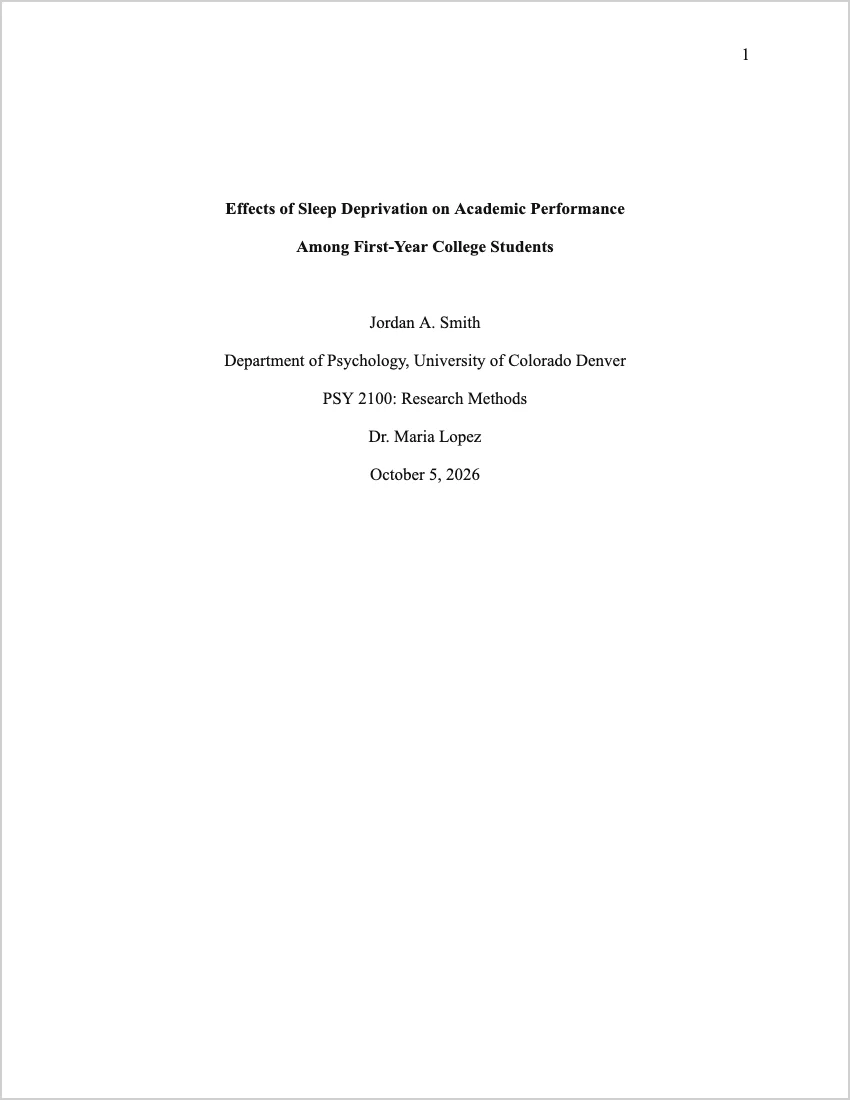
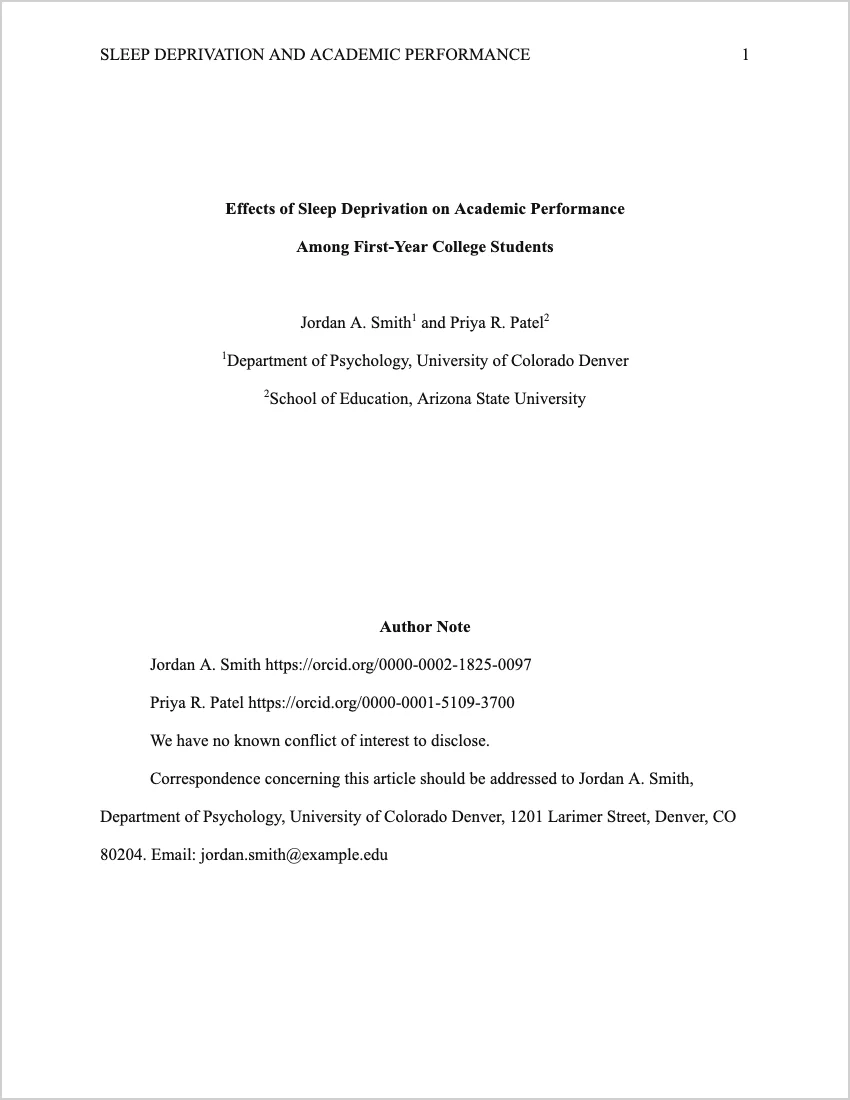
    An APA title page (also called the APA cover page) for a student paper (APA 7th edition) contains, in this order: the page number in the top right corner, the paper title in bold and centered three or four lines down from the top, one blank double-spaced line, then your name, your affiliation (department and university), the course number and name, the instructor’s name, and the due date. Everything is centered, double-spaced, and written in the same font as the rest of your paper. Professional papers add a running head, an author note, and superscript affiliations for multiple authors.

    Below you will find both versions with visual examples, the formatting rules that trip students up, step-by-step instructions for Word and Google Docs, and two free templates you can download and fill in.

    Free APA 7 title page templates (Word .docx)

    Both files use Times New Roman 12, double spacing, and 1-inch margins, and they open in Word, Google Docs, and LibreOffice.

    APA Title Page: Student vs. Professional

    APA 7 has two title page formats. If you are writing for a class, use the student version unless your instructor says otherwise. The professional version is meant for manuscripts that will be submitted to a journal, and for theses or dissertations when a graduate school asks for it.

    ElementStudent paperProfessional paper
    Page number (top right)YesYes
    Running headNo (only if your instructor asks)Yes, flush left in all caps
    Title in boldYesYes
    Author name(s)YesYes
    AffiliationDepartment and universityDepartment and university, with superscript numbers for multiple affiliations
    Course number and nameYesNo
    Instructor nameYesNo
    Due dateYesNo
    Author noteNoYes, in the bottom half of the page

    APA 6 vs. APA 7 Title Page

    In the 6th edition, every paper needed a running head: the words «Running head:» followed by the shortened title in capital letters on the title page, then only the shortened title on the pages that followed. The title was not bold, and the page had no lines for the course, instructor, or due date. The 7th edition made the title bold, dropped the «Running head:» label, and no longer requires a running head for student papers, which keep only the page number. Professional papers still use a running head, now without the label.

    APA Student Title Page

    Here is every element of the student title page, in the order it appears on the page:

    1. Page number. Put it in the header, flush right. The title page is page 1. Use Word’s automatic page numbering so it updates on every page.
    2. Paper title. Bold, centered, in title case, placed three or four lines down from the top margin. If the title is long, you can split it over two lines, but don’t break it in an awkward place.
    3. Blank line. Leave one double-spaced blank line between the title and your name.
    4. Author name(s). First name, middle initial, and last name, without titles (Dr.) or degrees (PhD). For two authors, separate the names with «and.» For three or more, use commas and put «and» before the last name.
    5. Affiliation. The department and the university, separated by a comma: «Department of Psychology, University of Colorado Denver.»
    6. Course number and name. Write it the way your school does, usually with a colon: «PSY 2100: Research Methods.»
    7. Instructor name. Use the form your instructor prefers, such as «Dr. Maria Lopez» or «Professor Lopez.»
    8. Due date. Use the format common in your country. In the United States that is month, day, year: «October 5, 2026.»
    APA 7 student title page example with page number, bold title, author, affiliation, course, instructor, and due date
    APA student title page example (7th edition)

    APA Professional Title Page

    The professional title page keeps the page number and the bold title, then changes the rest. These are the elements you need for a manuscript you plan to submit for publication:

    • Running head. A shortened version of your title in all capital letters, flush left in the header, on every page. APA 7 requires it for professional papers. Keep it to 50 characters or fewer, counting spaces and punctuation. The label «Running head:» from the 6th edition is no longer used.
    • Page number. Flush right on the same header line as the running head.
    • Title. Bold, centered, title case, three or four lines down from the top.
    • Byline. All author names on one line if they fit, centered, one blank line below the title.
    • Affiliations. When authors belong to different institutions, add a superscript number after each name and a matching superscript number before each affiliation line.
    • Author note. In the bottom half of the page, with the bold, centered label «Author Note.» Each paragraph is indented and can include ORCID iDs, changes of affiliation, disclosures and acknowledgments (funding, conflicts of interest), and a contact line that starts «Correspondence concerning this article should be addressed to…»
    APA 7 professional title page example with running head, authors with superscript affiliations, and author note
    APA professional title page example (7th edition)

    APA Title Page Formatting Rules

    The title page follows the same formatting as the rest of your paper. APA 7 accepts several fonts, as long as you use one consistently:

    • Calibri 11
    • Arial 11
    • Lucida Sans Unicode 10
    • Times New Roman 12
    • Georgia 11
    • Normal (10-point) Computer Modern, the LaTeX default

    For the full font rules, including headers, tables, and footnotes, see our guide to APA font requirements. The other rules for the title page:

    • Spacing: double-spaced throughout, with no extra space before or after paragraphs.
    • Margins: 1 inch on all sides. Our page on APA margins shows how to set them.
    • Alignment: everything on a student title page is centered except the page number.
    • Capitalization: the title goes in title case. Capitalize major words and any word with four or more letters; keep short articles, conjunctions, and prepositions lowercase unless they start the title or subtitle.
    • Title length: the 7th edition has no strict word limit, but APA asks for a focused title that tells readers the main topic. Aim for something a reader can take in at a glance, and cut phrases like «A Study of» or «An Investigation Into.»
    • No extras: no images, borders, underlining, or larger font sizes for the title.

    How to Make an APA Title Page in Word

    1. Open a blank document and set the font to Times New Roman 12 (or another APA font).
    2. Go to Layout > Margins and choose Normal (1 inch on all sides).
    3. Select all text, open Paragraph settings, set Line spacing to Double and Before/After to 0 pt.
    4. Go to Insert > Page Number > Top of Page > Plain Number 3 to place the number in the top right corner. For a professional paper, type the running head in the header, then press Tab until the number sits at the right margin.
    5. Press Enter three times, center the text (Ctrl+E or Cmd+E), type the title, and make it bold.
    6. Press Enter twice to leave one blank line, turn bold off, and type your name, affiliation, course, instructor, and date on separate lines.
    7. Insert a page break (Ctrl+Enter or Cmd+Enter) so your paper starts on page 2. Repeat the title in bold at the top of that page, then set the text to left alignment with a 0.5-inch first-line indent.

    If you want the full paper already set up, our APA format template for Word includes the title page, APA headings, and a reference page.

    Google Docs

    1. Open a blank document and choose File > Page setup. Set all margins to 1 inch and the paper size to Letter.
    2. Pick Times New Roman 12 and set Format > Line & paragraph spacing to Double. Remove the space before and after paragraphs.
    3. Go to Insert > Page numbers and choose the option that puts the number at the top right on every page, including the first.
    4. Center the text, press Enter three times, and type your bold title. Leave a blank line and add your details on separate lines.
    5. Use Insert > Break > Page break to start the body of your paper.

    You can also upload one of the templates above to Google Drive and open it with Google Docs. The page number field and spacing carry over.

    Common APA Title Page Mistakes

    MistakeWhat to do instead
    Adding a running head to a student paperLeave it out unless your instructor or school requires it
    Writing «Running head:» before the shortened titleOnly type the shortened title in all caps (professional papers)
    Title not in bold, or in a bigger fontBold, same size as the body text
    Title placed in the exact middle of the pageStart it three or four lines down from the top margin
    No blank line between title and author nameLeave one double-spaced blank line
    Adding degrees (PhD, MA) after namesUse first name, middle initial, and last name only
    Leaving out the department in the affiliationWrite «Department, University»
    Single spacing the lines to fit everythingKeep the whole page double-spaced
    Numbering the title page as 0 or leaving it unnumberedThe title page is page 1

    Frequently Asked Questions

    Does a student paper need a running head in APA 7?

    No. APA 7 dropped the running head from student papers. Add one only if your instructor or institution asks for it.

    Is the title page counted as page 1?

    Yes. The page number 1 appears in the top right corner of the title page, and the first page of text is page 2.

    How do I list two authors from the same university?

    Put both names on one line, joined by «and,» with a single affiliation line underneath. Superscript numbers are only needed when the authors have different affiliations.

    Is the APA title page the same as the MLA or Chicago one?

    No. MLA usually skips a separate title page, and Chicago uses a different layout. Our comparison of title page formats in APA, MLA, and Chicago shows each one side by side.

    Related APA Guides

  • APA Headings: 5 Levels Explained with Examples (2026)

    APA 7th edition uses a five-level heading system to organize academic papers. Each level has specific formatting requirements, and using them correctly demonstrates that your paper is professionally structured. This guide explains every level of APA headings with exact formatting rules and examples. In short: Level 1 is centered and bold; Level 2 is flush left and bold; Level 3 is flush left, bold, and italic; Level 4 is indented, bold, and ends with a period; Level 5 is indented, bold italic, and ends with a period. All five levels use title case.

    APA Headings: All 5 Levels

    LevelFormatExample
    1Centered, Bold, Title CaseMethod
    2Left-aligned, Bold, Title Case. Text begins as a new paragraph.Participants
    3Left-aligned, Bold Italic, Title Case. Text begins as a new paragraph.Demographic Characteristics
    4Indented 0.5″, Bold, Title Case, Period. Text begins on same line.     Age and Gender Distribution. Ages ranged from…
    5Indented 0.5″, Bold, Italic, Title Case, Period. Text begins on same line.     Gender Breakdown by Age Group. Female participants…

    APA Heading Level 1

    Level 1 headings are used for major sections of the paper. They are centered, bold, and in title case (capitalize the first letter of every word of four letters or more, plus the first word and any word after a colon). In a standard APA paper, Level 1 headings include the paper title (see the APA title page) on the first page of the body, Method, Results, Discussion, Conclusion, and References.

    Important rule: The introduction does not use the heading «Introduction.» Instead, the paper title, repeated at the top of the first body page, serves as the Level 1 heading for the introduction. This is one of the most commonly confused APA formatting rules.

    Example Level 1 heading:
    Method

    APA Heading Level 2

    Level 2 headings are used for subsections within a Level 1 section. They are left-aligned and bold (not italic), in title case. The text begins on the next line as a new paragraph with a standard first-line indent.

    In the Method section, Level 2 headings typically include Participants, Materials, Measures, and Procedure. In the Discussion section, Level 2 headings might include Limitations, Implications, and Future Directions.

    Example Level 2 heading:
    Participants
    (text begins here on the next line, indented)

    APA Heading Level 3

    Level 3 headings are used for subsections within a Level 2 section. They are left-aligned (not indented), bold, and italic, in title case, with no period. The text begins on the next line as a new paragraph with a standard first-line indent.

    Example Level 3 heading:
    Demographic Characteristics
    The sample consisted of 148 full-time employees aged 22–35…

    APA Heading Level 4

    Level 4 headings are used for subsections within a Level 3 section. They are indented 0.5 inches from the left margin, bold (but not italic), in title case, and end with a period. The paragraph text begins on the same line immediately after the period.

    Example Level 4 heading:
        Age and Gender Distribution. Female participants (n = 82) ranged in age from 22 to 35…

    APA Heading Level 5

    Level 5 headings are used for the most specific subsection level. They are indented 0.5 inches, bold and italic, in title case, and end with a period. The paragraph text begins on the same line immediately after the period. Level 5 headings are rarely needed in student papers; they are more common in dissertation chapters or long empirical reports.

    Example Level 5 heading:
        Gender Breakdown by Age Group. Female participants in the 22–25 age cohort…

    How Many Heading Levels Does a Student Paper Need?

    Most undergraduate papers use only Level 1 headings. Many graduate research papers use Levels 1 and 2. Dissertations and longer empirical reports may use Levels 1, 2, and 3. Levels 4 and 5 are only needed for complex, multi-level structures that are rarely required in coursework.

    APA requires that you use headings in order — you cannot skip from Level 1 to Level 3 without using Level 2. However, you can use only Level 1 or only Levels 1 and 2 if your paper’s structure doesn’t require deeper subdivision.

    APA Paper Structure: Where Each Level Goes

    Here is how a standard APA empirical paper is typically structured using headings:

    [Paper Title] — Level 1 (serves as the Introduction heading)

    Method — Level 1
    Participants — Level 2
    Materials — Level 2
    Measures — Level 2
    Primary Outcome Measure — Level 3 (if the Measures section has subsections)
    Procedure — Level 2

    Results — Level 1
    Descriptive Statistics — Level 2
    Hypothesis Testing — Level 2

    Discussion — Level 1
    Limitations — Level 2
    Implications — Level 2
    Future Directions — Level 2

    Conclusion — Level 1 (if separate from Discussion)

    References — Level 1

    APA Heading Formatting in Microsoft Word

    To format APA headings correctly in Word without manually adjusting each one, use Word’s built-in paragraph styles. However, Word’s default Heading 1, Heading 2, etc. styles don’t match APA formatting — you’ll need to modify them.

    Alternatively, the APA Format Template on this site has all five heading levels pre-formatted correctly. You can apply them by selecting text and clicking the appropriate style in Word’s Styles gallery, or simply type your headings using the exact formatting described above.

    Common APA Heading Mistakes

    • Using «Introduction» as a heading — APA does not use «Introduction» as a heading. The paper title on the first body page serves that function.
    • Skipping heading levels — You must use levels in order. You cannot use Level 3 without Level 2.
    • Centering Level 2 headings — Level 2 is left-aligned, not centered. Only Level 1 is centered.
    • Omitting the period after Levels 4 and 5 — Levels 4 and 5 end with a period, and the paragraph text begins on the same line. Levels 1, 2, and 3 do not end with a period and are followed by text on the next line.
    • Not bolding all headings — All five APA heading levels are bold. Levels 3 and 5 are also italic. Levels 1, 2, and 4 are bold but not italic.

    APA Headings vs. Headers

    Headings label the sections of your text. The page header is the top margin of each page, where the page number appears; professional papers also include a running head there. For the header, see APA page numbers format and APA running head format.

    Frequently Asked Questions

    Do I need to use all five APA heading levels?

    No. Use only as many heading levels as your paper’s structure requires. Most student papers use one or two levels. Start with Level 1 for major sections. Add Level 2 if major sections have multiple named subsections. Only add Level 3 if those subsections need further subdivision. More levels than the structure requires creates unnecessary complexity.

    APA Headings: 6th vs. 7th Edition

    APA 7th edition simplified the heading system: Levels 1 and 2 stayed the same, while Levels 3, 4, and 5 changed.

    Level6th edition7th edition
    1Centered, bold, title caseCentered, bold, title case
    2Flush left, bold, title caseFlush left, bold, title case
    3Indented, bold, lowercase (sentence-style) capitalization, ends with a period; text runs onFlush left, bold italic, title case; text begins on the next line
    4Indented, bold italic, lowercase (sentence-style) capitalization, ends with a period; text runs onIndented, bold, title case, ends with a period; text runs on
    5Indented, italic, lowercase (sentence-style) capitalization, ends with a period; text runs onIndented, bold italic, title case, ends with a period; text runs on

    The 7th edition uses title case for all levels and puts Level 3 on its own line, flush left. Its formatting is more consistent: all five levels are bold, Levels 3 and 5 add italic, and Levels 4 and 5 run into the paragraph text.

    Related Resources

  • How to Write an Annotated Bibliography: APA, MLA, and Chicago (2026)

    An annotated bibliography is more than a list of sources. It is a research tool that shows you—and your professor—that you have read, understood, and critically evaluated the sources you plan to use. This guide shows you exactly how to write an annotated bibliography in APA, MLA, and Chicago format, with complete examples for each.

    What Is an Annotated Bibliography?

    An annotated bibliography is a list of sources—books, articles, websites, and other materials—where each entry includes a citation followed by a paragraph (the annotation) that describes and evaluates the source. The annotation tells the reader what the source is about, how reliable or credible it is, and why it is (or is not) useful for your research.

    Annotated bibliographies serve two purposes. As a standalone assignment, they demonstrate your ability to find, read, and evaluate sources. As a preparatory step, they are the research foundation for a literature review, research paper, or thesis.

    Types of Annotations

    • Descriptive (informative)—Summarizes the content of the source without evaluation. Answers: what does this source say? Used when the assignment asks only for summaries.
    • Evaluative (critical)—Assesses the quality, reliability, and relevance of the source. Answers: is this source credible and useful for my research? Used when the assignment requires critical analysis.
    • Combination—Summarizes and evaluates. This is the most common type requested in academic assignments. Each annotation describes the source and then assesses its value for your specific research question.

    How to Write an Annotation: Step-by-Step

    Most annotations are 100–200 words and cover four elements:

    1. Summary—What is the source’s main argument or purpose? What does it cover? One to three sentences.
    2. Authority/Credibility—Who wrote it? What are the author’s credentials? Where was it published? Is it peer-reviewed? One sentence.
    3. Evaluation—What are the source’s strengths and limitations? Is the evidence convincing? Are there biases? One to two sentences.
    4. Relevance—How does this source contribute to your specific research question or paper? One sentence.

    Annotated Bibliography Examples by Citation Style

    APA Annotated Bibliography Example

    Brown, T., Williams, K., & Patel, S. (2023). Longitudinal effects of cognitive training on academic outcomes in underrepresented students. Journal of Educational Psychology, 115(4), 812–829. https://doi.org/10.1037/edu0000000

    This longitudinal study examined the effects of a 12-week cognitive training intervention on GPA and standardized test scores among first-generation college students. Using a randomized controlled design with 240 participants across four universities, the authors found significant improvements in working memory and academic performance in the intervention group compared to controls. The study is published in a peer-reviewed APA journal and the randomized design strengthens causal inference. The primary limitation is the homogeneous sample drawn from a single geographic region, which may limit generalizability. This source directly supports the section on evidence-based interventions for academic performance in first-generation students.

    Formatting note: In APA, the annotation is indented 0.5 inches from the left margin (same as a regular paragraph). The citation uses standard APA reference list format. The entire entry is double-spaced.

    MLA Annotated Bibliography Example

    Clarke, Emily. «Close Reading in the Digital Age.» New Literary History, vol. 54, no. 1, 2023, pp. 34–58.

    Clarke argues that the proliferation of digital archives has not replaced the need for close reading but instead has shifted the nature of the skill required, from sustained textual analysis toward pattern recognition across large corpora. The author is a professor of English at a research university and the article is published in one of the field’s leading peer-reviewed journals. Clarke’s argument is lucidly structured but relies heavily on a small set of exemplary cases rather than systematic evidence. The article is particularly relevant to the section on methodology, where I argue that digital tools and traditional close reading are complementary rather than competing approaches.

    Formatting note: In MLA, the citation uses standard Works Cited format with a hanging indent. The annotation is indented to align with the second line of the citation and written in continuous prose.

    Chicago Annotated Bibliography Example

    Smith, Jane. Advanced Research Methodology. New York: Routledge, 2023.

    Smith provides a comprehensive methodological guide for graduate students conducting qualitative and mixed-methods research in the social sciences and humanities. Chapters four and five, covering thematic analysis and interview design respectively, are most directly relevant to this project. The author holds a distinguished professorship in research methods at a major research university and the book is widely assigned in graduate courses, lending it considerable authority. A potential limitation is that the book’s examples skew toward social science contexts and less frequently address humanistic inquiry. Despite this, the methodological framework Smith proposes adapts readily to humanities research and will inform the analytical approach used in this dissertation.

    Annotated Bibliography Format Rules

    APA Format

    Heading: «Annotated Bibliography» or «Annotated References» — centered, bold. Citations follow APA 7th edition reference list format. Annotations are indented 0.5 inches. Entries are alphabetical by author’s last name. Double-spaced throughout with no extra line between entries.

    MLA Format

    Heading: «Annotated Works Cited» — centered, not bold. Citations follow MLA 9th edition Works Cited format with hanging indent. Annotations begin on the line immediately below the citation, indented to align with the hanging indent continuation. Entries are alphabetical. Double-spaced throughout.

    Chicago Format

    Heading: «Annotated Bibliography» — centered. Citations follow Chicago bibliography format (Notes-Bibliography system): hanging indent, periods between elements. Annotations follow immediately below the citation, double-spaced. Entries are alphabetical by author’s last name.

    Common Annotated Bibliography Mistakes

    • Writing only summaries—A descriptive-only annotation that never evaluates the source is incomplete for most assignments. Always check whether your assignment requires evaluation.
    • Being too general—»This source is helpful for my research» is not an evaluation. Be specific: identify what aspect of the source is useful and why.
    • Ignoring limitations—A credible annotation acknowledges the source’s weaknesses (limited sample, dated findings, theoretical bias) as well as its strengths.
    • Using quotations in the annotation—Annotations should paraphrase and summarize in your own words. Direct quotes are rarely appropriate.
    • Not linking to your research question—The annotation should explain specifically how the source contributes to your project, not just what the source is about.

    Frequently Asked Questions

    How long should an annotation be?

    Typically 100–200 words per annotation. Some assignments specify a target length; follow those instructions. Annotations should be dense with information — every sentence should either describe, evaluate, or connect the source to your research. Padding and vague praise waste words that should contain substantive analysis.

    Is an annotated bibliography the same as a literature review?

    No. An annotated bibliography lists sources individually, each with its own annotation. A literature review synthesizes sources thematically, discussing how they relate to each other and to your research question in continuous prose. An annotated bibliography is often a step toward writing the literature review; the two are different assignments with different structures.

    Do I have to include every source I read?

    Not necessarily. An annotated bibliography typically includes sources that are relevant to your research question. Sources you read and discarded as irrelevant are usually not included unless the assignment specifically asks for a comprehensive search record. Include sources that you are planning to use or that provide important context, even if you ultimately don’t cite them in the final paper.

    Related Resources